
Soft and hard molding are not separate machines; they are different material-and-process choices within plastic injection molding. The right option depends on flexibility, load, appearance, cost, and the product’s working environment.
Overview of soft vs hard molding
Soft molding produces parts with lower hardness and greater elasticity, whereas hard molding produces parts with higher rigidity and better shape retention. In practice, both rely on injection molding, but they serve different product functions and quality targets.
Soft materials are often chosen for grips, seals, protective covers, and comfort-focused parts. Hard materials are more common in housings, brackets, containers, and structural components where stiffness matters more than flexibility.
For a broader view of service capability, many buyers start with injection molding services and then narrow the project to a specific resin family and part function. If the project involves enclosures or consumer-facing shells, a dedicated plastic case mold page is often the most relevant starting point.
Key differences at a glance
Material stiffness is the clearest difference between soft and hard molding, but it is not the only one. The table below summarizes the main engineering distinctions that affect part performance and tooling decisions.
Comparison Table: Soft Plastic Molding vs Hard Plastic Molding
| Factor | Soft Plastic Molding | Hard Plastic Molding |
|---|---|---|
| Typical behavior | Flexible, compressible, and impact-absorbing | Rigid, stable, and load-bearing |
| Common materials | TPE, TPU, TPU blends, soft PVC | ABS, PC, PP, HIPS, PA |
| Primary goal | Comfort, sealing, grip, cushioning | Strength, precision, appearance, structure |
| Tooling focus | Flow balance, demolding, shrink control | Dimensional accuracy, gate placement, surface finish |
| Typical risks | Flash, deformation, tackiness, over-compression | Sink marks, warpage, brittle failure, stress whitening |
Part geometry also changes the outcome, because flexible resins can tolerate some deformation while rigid resins cannot. That is why the same cavity design may perform well for one resin and fail for another.
According to the U.S. EPA, plastics molding and forming is a broad industrial category used for consumer and industrial products across sectors such as electronics, appliances, construction, and medical goods. That breadth explains why resin choice must be tied to end use, not just to part appearance.
Material and process selection in plastic injection molding
Material selection determines whether a part behaves like a soft functional component or a hard structural one. In plastic injection molding, the resin’s melt flow, shrink rate, hardness, and thermal response shape the final result more than the machine itself.
Soft materials usually need careful control of packing pressure and cooling time because they can deform during ejection. Hard materials usually need tighter control of mold temperature, gate design, and wall thickness to reduce warpage and sink marks.
Comparison Table: Common Resin Families and Their Typical Use Cases
| Resin family | Relative hardness | Typical use case | Notes |
|---|---|---|---|
| TPE / TPU | Soft | Seals, grips, wear parts | Good elasticity and tactile feel |
| Soft PVC | Soft | Flexible covers, low-cost soft parts | Requires careful process and compliance review |
| ABS | Hard | Housings, consumer shells | Good balance of stiffness and finish |
| PC | Hard | PC case mold applications, transparent or impact-resistant parts | Strong but sensitive to processing conditions |
| PP | Hard to semi-rigid | Boxes, lids, daily-use products | Lightweight and chemically resistant |
Scientific process control matters in both cases. DOE-based optimization is widely used in injection molding to identify the process window that improves repeatability and reduces defects. Industry resources from SPE and technical guidance on scientific molding both emphasize controlled experimentation rather than trial-and-error alone.
For projects that need custom geometry, a custom injection moulding workflow is usually more practical than selecting a standard catalog part. If the product is a finished consumer item rather than a single component, the broader plastic product category can help align the resin, mold, and assembly requirements.
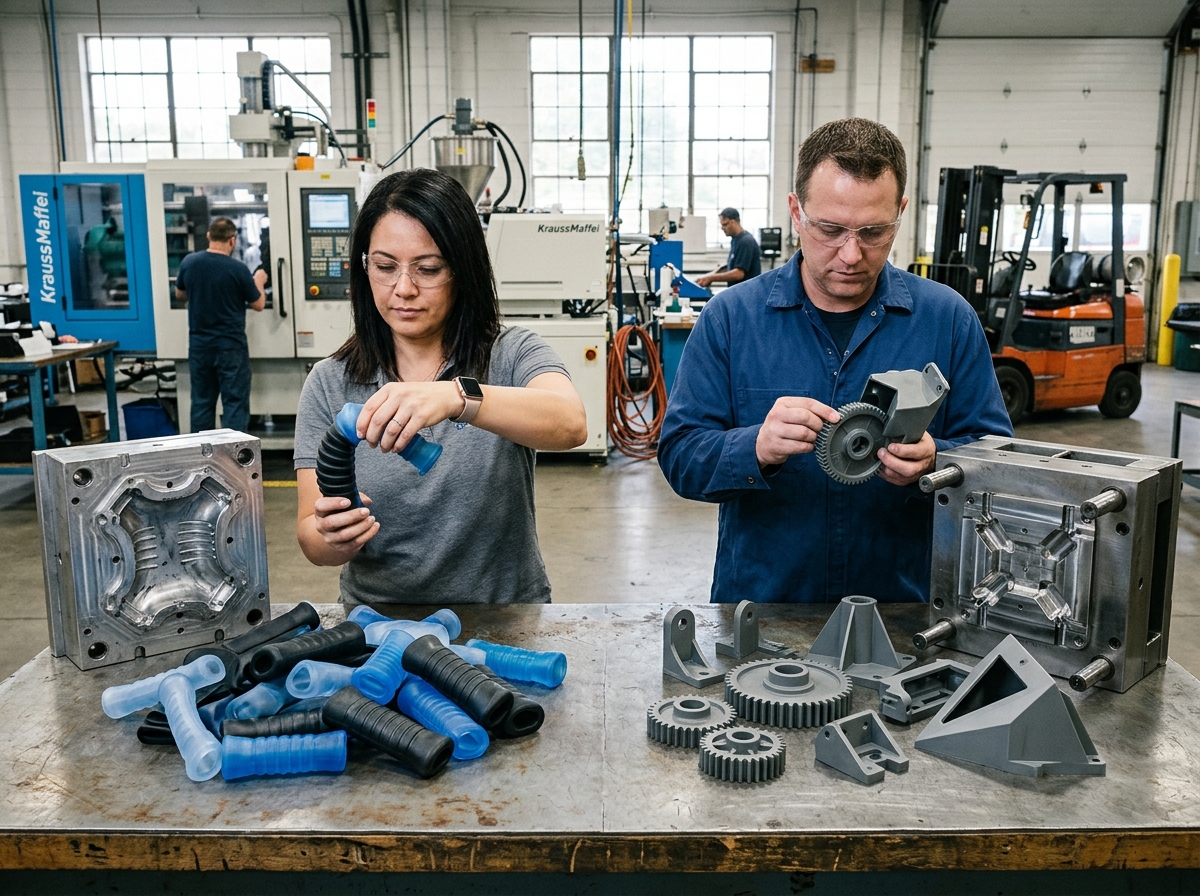
Design and tooling considerations for soft and hard parts
Tooling design changes significantly between flexible and rigid parts because each resin family fills and releases differently. Soft parts often need smoother ejection, more attention to draft angles, and gate locations that reduce visible flow marks.
Hard parts usually demand tighter dimensional control, especially when the part must mate with another component. In these cases, wall thickness uniformity, rib design, and cooling layout are critical to prevent distortion after molding.
For enclosure projects, the mold must support both appearance and assembly. A PC case mold typically needs better control of snap fits, screw bosses, and cosmetic surfaces than a general-purpose container mold.
When the geometry is complex, 3D mold development can reduce risk by addressing curved surfaces, undercuts, and detailed features earlier in the design stage. That is especially useful for parts where visual quality and functional fit must be balanced in one tool.
Industry standards also help define the expected mold life and finish level. SPE and related industry references show that mold class, finish, and tolerance expectations should be matched to production volume and part requirements rather than chosen by habit.
Typical applications and selection logic
Application context is the fastest way to decide between soft and hard molding. If the part must flex, cushion, or seal, soft materials are usually the better fit; if the part must support load or hold shape, hard materials are usually preferred.
- Soft molding is common in grips, gaskets, wearable accessories, and protective edges.
- Hard molding is common in electronics housings, appliance shells, storage boxes, and structural brackets.
- Mixed-material designs are used when a rigid body needs a soft-touch surface or sealing layer.
In electronics manufacturing, rigid shells are often selected because they protect internal components and preserve assembly tolerances. In consumer goods, soft-touch features may be added only where user contact or sealing performance is important.
For buyers comparing suppliers, one-stop development can reduce coordination risk because design, tooling, trial runs, and production stay under one workflow. A service page such as professional injection moulding services is useful when the project needs both mold creation and production support.
Environmental and compliance planning should not be ignored. EPA guidance on plastics management highlights lifecycle considerations, while the federal effluent category for plastics molding and forming shows that industrial processing is regulated in relevant contexts.
Supplier directory and where to buy
Supplier selection should follow the part type, not the other way around. For buyers who need a broad manufacturing partner, the most useful entry points are service pages, product categories, and application-specific mold pages.
Recommended internal starting points
- Main website homepage for company overview and general contact access.
- Injection molding services for production-oriented projects.
- Plastic case mold for enclosure and housing projects.
- PC case mold for electronics shell development.
- Custom injection moulding for OEM and ODM parts.
For a complete market comparison, buyers may also evaluate other established industry suppliers and local mold makers that specialize in their target resin, volume, and delivery region. The best choice is usually the one that can prove material experience, stable trial results, and repeatable mass production.
FAQ
1. Is soft plastic molding a different process from hard plastic molding?
It is usually the same injection molding process, but with different resins, mold settings, and quality targets. Soft parts need flexibility and controlled ejection, while hard parts need rigidity, dimensional stability, and stronger structural performance.
2. Which materials are most common for soft plastic molding?
TPE and TPU are among the most common choices because they provide elasticity, grip, and cushioning. Soft PVC is also used in some applications, but it requires careful compliance review and process control depending on the end market.
3. Why do hard plastic parts often need tighter mold control?
Hard parts usually have less tolerance for shrinkage, warpage, and stress concentration. That means gate design, cooling balance, and wall thickness uniformity become more important, especially for housings, covers, and precision-fit components.
4. Can one mold produce both soft and hard parts?
Yes, but usually not in the same cavity setup without special design. Overmolding or two-shot molding can combine rigid and flexible materials, yet the tool must be engineered for bonding, sequencing, and different shrink behaviors.
5. How should a buyer choose between soft and hard molding for a new product?
Start with the part’s function, then define the required feel, load, appearance, and assembly tolerance. If the part must bend or seal, choose a soft material. If it must protect, support, or hold shape, choose a hard material.
Post time: Jul-06-2026