
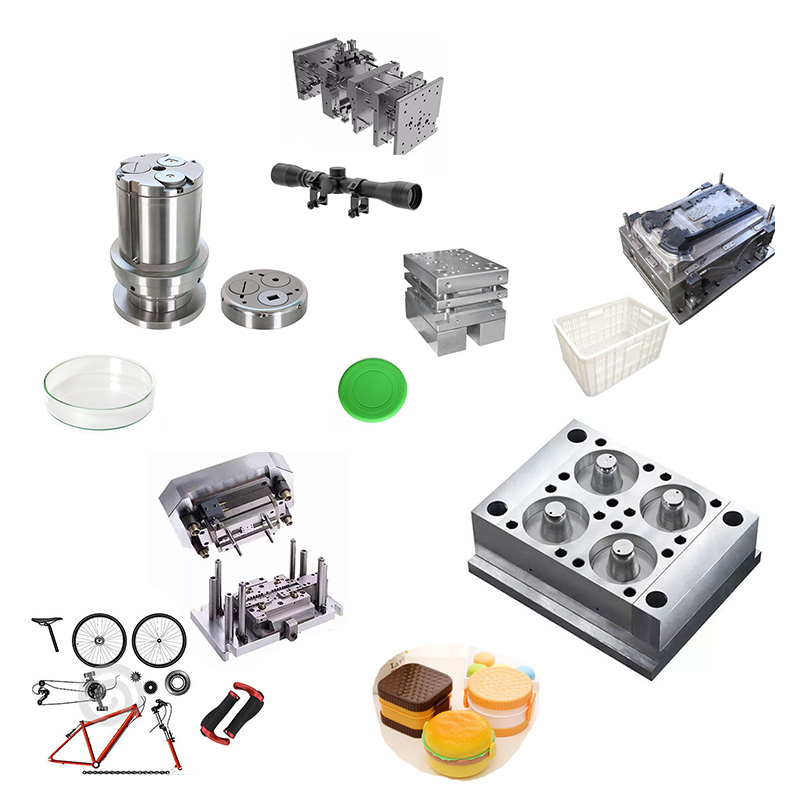
The use of inserts is mainly to solve a series of problems in mold manufacturing, usage and maintenance, and its application scenarios are very extensive.
1. Facilitates processing and reduces manufacturing difficulty
Deep cavity and narrow groove processing: Some very deep and very narrow ribs or grooves on the mold. If processed directly on the entire mold core, the cutting tools (milling cutters, electrodes) are long and thin, prone to shaking, wear and even breakage, resulting in low processing efficiency and difficult to ensure accuracy. By designing them as independent inserts, they can be processed separately, and even better processes such as wire cutting can be adopted, significantly reducing the processing difficulty and cost.
Complex shape processing: For parts with extremely complex shapes that are difficult to polish, they can be made into inserts and then undergo detailed processing, polishing, or etching (such as leather texture, embossing) separately, resulting in better effects.
2. Easy to maintain and replace, extending the lifespan of the mold
Weaker parts: Some parts of the mold are prone to wear, erosion or damage during the injection molding process, such as:
Small core holes (through-punching/through-insertion positions): These positions are subjected to significant force during the mold closing process and are prone to chipping or wear.
Near the gate: The high-speed and high-pressure plastic melt is constantly eroding, which can easily cause damage.
If the entire mold core is made as a single unit, once these parts are damaged, the entire expensive mold core needs to be repaired or replaced, which is costly and time-consuming. However, with the use of inserts, only the damaged insert needs to be removed for repair or replacement of a new one. “Replace where it’s broken”, this greatly saves time and cost.
3. Optimize the mold cooling system
Local enhanced cooling: Certain areas on the product are particularly thick and prone to forming cracks. A separate cooling water channel can be designed within the corresponding insert to conduct targeted enhanced cooling, effectively improving product quality.
Solving waterway interference: Sometimes the cooling waterways on the mold core may interfere with the punch, screws, etc. By using inserts, the waterways can be designed inside the inserts, ingeniously avoiding the interference problem.
4. Save high-quality steel and reduce costs
The mold cores usually require the use of high-performance and expensive mold steels (such as S136, H13, etc.) to ensure overall strength and lifespan.
For some specific local structures (such as slender cores), special steel with better toughness or higher wear resistance (such as hard alloy) can be used to make inserts. This not only meets the local high-performance requirements, but also avoids using expensive materials for the entire mold core, thus achieving cost optimization.
5. Facilitates exhaust
The mating surface between the insert and the mold core can naturally form exhaust grooves, which helps to discharge the air in the mold cavity and the gases produced by the decomposition of plastic, thereby reducing defects such as trapped air and burning of the product.
6. Achieve product diversification
By changing different inserts, variations can be made in different parts of the product on the same set of molds. For example, a series of products with different dates, different logos, or different specifications can be produced, thereby enhancing the flexibility of the molds.
Post time: Jan-23-2026