
- CNC machining is usually better for speed, design iteration, and low-volume production.
- Custom plastic parts made by injection molding usually deliver lower unit cost and stronger repeatability at scale.
- Tooling, tolerance stack-up, and cosmetic requirements often matter more than raw material price.
- For buyers, the real decision is total cost of ownership, not just part price.
- Supplier support in DFM, mold validation, and production stability can change the final outcome significantly.
Custom plastic parts and CNC machining solve different manufacturing problems, and the cost and quality answer depends on where your project sits in the product lifecycle. ISO 20457:2018 defines general tolerances for plastics molded parts, while ISO 20457:2018 and NIST engineering metrology resources emphasize that plastic dimensions must be judged in the context of process capability, shrinkage, and inspection method, not by material alone. For buyers comparing custom plastic parts with CNC machining, the real question is whether you need fast iteration, tight dimensional control, surface quality, or the lowest cost at volume. A qualified supplier can help you choose between prototypes, bridge production, and full-scale plastic manufacturing, especially for consumer electronics, appliance housings, industrial covers, and functional enclosures.
Custom Plastic Parts vs CNC Machining: the core cost and quality tradeoff
The core tradeoff is simple: CNC machining reduces upfront risk, while injection-molded custom plastic parts reduce per-unit cost at scale.
That difference shows up in both time and money. CNC machining of plastics typically avoids hard tooling, so design changes can be absorbed quickly. Injection molding requires a mold, but once the tool is validated, each shot can produce multiple parts with far better repetition and lower labor cost per unit. For procurement teams, this means CNC machining is often the better answer for first articles, pilot runs, and urgent launches, while plastic manufacturing with molds is better for stable designs and recurring demand.
For quality, molded parts usually offer stronger repeatability once the process is tuned. CNC parts can achieve excellent precision, but the final quality depends more heavily on setup, fixturing, tool wear, and operator control. In plastic manufacturing, the tool itself becomes part of the quality system, which is why mold design, venting, gate location, cooling balance, and ejection strategy matter so much for custom plastic parts.
| Factor | CNC Machining | Injection Molded Custom Plastic Parts |
|---|---|---|
| Upfront tooling cost | Low | High |
| Typical lead time | Days to 2 weeks | Weeks to months |
| Best volume range | 1 to 500 pieces | 1,000 pieces and above |
| Repeatability | Good | Excellent after validation |
| Design change flexibility | High | Lower after tooling release |
| Unit cost at scale | Higher | Lower |
Why custom plastic parts often win on total cost
Injection molded custom plastic parts usually win on total cost when annual demand is stable enough to amortize tooling.
The reason is not just machine time. Molded production spreads the cost of mold development across every finished part, and the cycle time per part can be very short. For many commodity thermoplastics, cycle times of roughly 20 to 60 seconds are common depending on wall thickness, cooling design, and part mass. That is one reason plastic manufacturing can outperform CNC machining on cost once quantities rise. This is especially true for housings, clips, cosmetic covers, and structural enclosures where the part geometry is repeatable.
A second cost advantage is material yield. CNC machining removes material from a billet or sheet, which creates chips and scrap. Injection molding meters only the required polymer into the cavity, so the effective material utilization is often better for high-volume custom plastic parts. For buyers, that can translate into lower material waste, lower labor content, and less post-processing.
For example, if a consumer electronics shell needs thousands of identical units, the mold may be expensive upfront, but the per-unit cost can drop sharply once the program runs at scale. If the design is still changing every week, CNC machining protects you from paying for a mold that becomes obsolete.
| Cost Element | CNC Machining | Injection Molding |
|---|---|---|
| Tooling investment | $0 to low | Moderate to high |
| Material waste | Higher due to chip removal | Lower after process stabilization |
| Labor per part | Higher | Lower at volume |
| Best financial fit | Prototype and short run | Mass production |
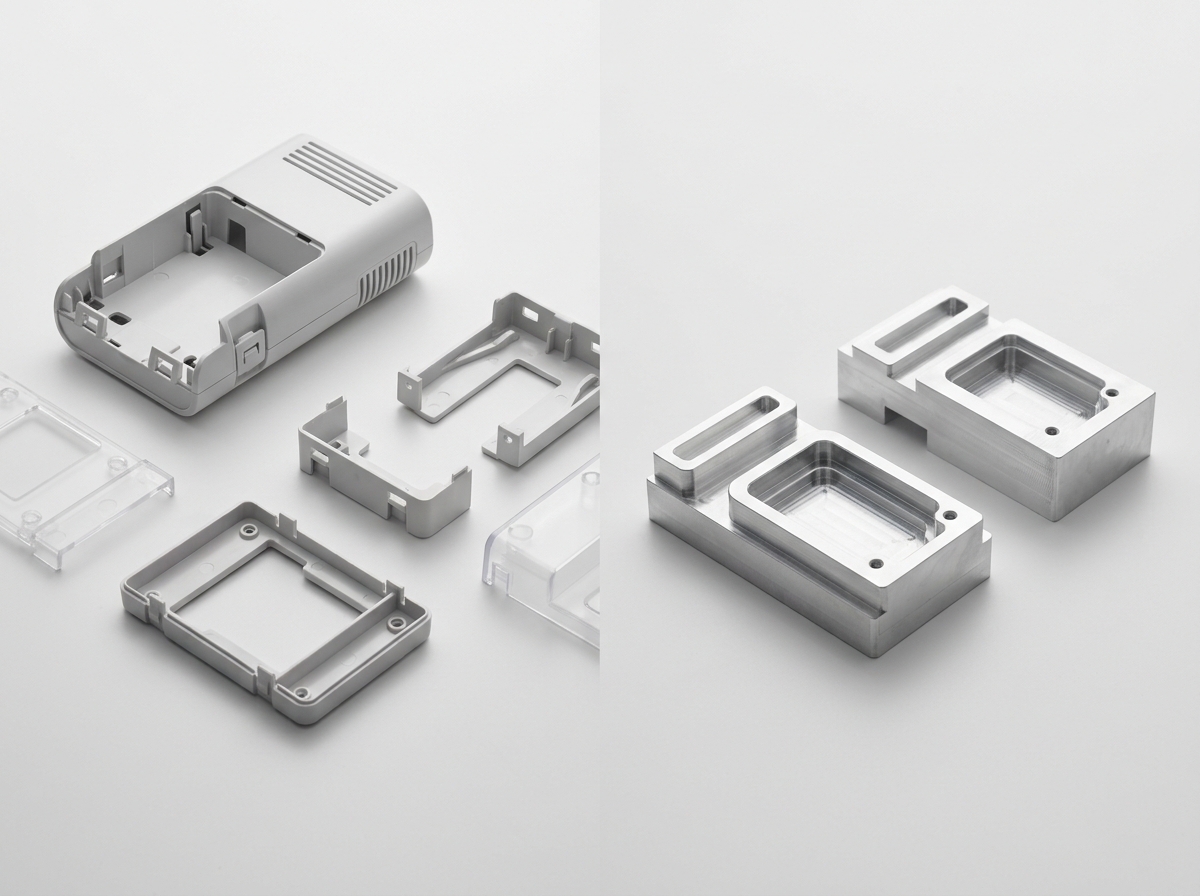
Why CNC machining can deliver better quality for early-stage projects
CNC machining often delivers better practical quality when the design is still moving.
That is because machining lets engineers test geometry without waiting for mold steel. For custom plastic parts, this matters when wall thickness, draft angles, snap fits, rib height, and boss locations are not fully frozen. A machined prototype can reveal fit issues, assembly interference, and ergonomic problems before the mold is built. In fast-moving industries, that can save both time and money.
Quality in CNC plastic parts is also easier to inspect in a classic metrology workflow. Coordinate measuring machines, go/no-go gauges, and digital calipers can verify dimensions directly after machining. But buyers should remember that plastic is not metal: heat, stress relief, and toolpath strategy can affect flatness and edge finish. A clean machined part can still warp later if the wrong polymer or fixture strategy is used.
For critical assemblies, it is common to use CNC machining for prototype validation and then switch to custom plastic parts made by injection molding after dimensions and cosmetics are locked. That hybrid approach reduces risk while keeping the final unit cost under control.
- Use CNC machining when tolerances are still being negotiated.
- Use CNC machining when part geometry may change after user testing.
- Use injection molding when repeatability and cost per part matter most.
- Use both when you need a prototype-to-production transition path.
Quality standards that matter in plastic manufacturing
Quality for custom plastic parts is defined by process capability, not by appearance alone.
For molded plastics, ISO 20457:2018 provides a framework for tolerance expectations in plastics molded parts, which helps buyers distinguish what can be held consistently and what requires special process control. For general machining and coordinate verification, ISO 2768-1 is often used as a general tolerance reference in many industries, though plastic parts still need design-for-manufacture review because shrinkage and moisture behavior differ from metal.
Typical molding precision is often discussed in the range of around ±0.05 mm to ±0.10 mm for well-controlled features, but the actual achievable tolerance depends on resin, part size, wall thickness, tooling quality, and measurement method. For cosmetic housings, surface quality and assembly fit may matter more than a single dimension tolerance number. For functional parts, draft angle, gate vestige, sink control, and weld-line placement can determine whether the part passes.
That is why professional plastic manufacturing is not just about molding a shape. It is about building a stable process window that preserves quality over a full production run.
| Quality Topic | CNC Machining | Custom Plastic Parts |
|---|---|---|
| Dimensional drift | Driven by tool wear and setup | Driven by shrinkage and process stability |
| Surface finish | Toolpath-dependent | Mold-texture-dependent |
| Part-to-part repeatability | Moderate to high | High after process tuning |
| Best inspection focus | Geometry and edge quality | Shrinkage, warpage, cosmetics, fit |
How to choose between custom plastic parts and CNC machining
The best process choice comes from volume, design stability, and required quality level.
If you are launching a new enclosure or cover and still expect revisions, CNC machining is usually the safer path. If your design is frozen and demand is expected to repeat, custom plastic parts made by injection molding usually deliver the best economics. If you are producing 3D-shaped housings, irregular cosmetic parts, or parts with complex clip features, mold design becomes more valuable because it can reproduce those features consistently.
When comparing suppliers, ask about DFM support, resin selection, mold steel, validation samples, and production turnaround. A strong plastic manufacturing partner should be able to explain why a feature is risky, where wall thickness needs adjustment, and how the gating strategy affects appearance. This is especially important for injection mold solutions, custom plastic parts, plastic enclosure molds, and 3D mold development where geometry, cosmetics, and repeatability must align.
- Confirm annual volume and expected reorder frequency.
- Freeze the design enough to evaluate tooling risk.
- Estimate prototype cost versus mold amortization.
- Check whether cosmetic quality or functional tolerance is the priority.
- Review supplier DFM comments before release.
Industry examples: where each process works best
Different product categories push the decision in different directions.
For consumer electronics, plastic manufacturing usually favors molded custom plastic parts because cosmetic consistency, snap-fit integrity, and assembly speed are critical. For household appliances, large housings and repeated production cycles make tooling investment easier to justify. For industrial parts, the decision depends on whether the component is a one-time bracket, a service part, or a long-life enclosure with recurring demand. For toys and lifestyle products, surface finish and color consistency often matter as much as mechanical strength.
In a real sourcing workflow, buyers often start with CNC machining to validate fit, then move into plastic injection mold development once the product is stable. That sequence is common because it protects the launch schedule while still enabling a lower cost structure later. If a product line needs multiple variants, suppliers that can support OEM and ODM service are often easier to work with because design, tooling, and production feedback stay under one roof.
Material choice changes the result more than many buyers expect
Material selection can decide whether custom plastic parts outperform CNC machining in the real world.
PC, ABS, PP, PA, and POM each behave differently in both machining and molding. Polycarbonate is often chosen for transparent or impact-resistant housings, which is why it appears so often in protective covers and electronic shells. ABS is popular for appearance-driven parts because it is easy to mold and paints well. PP offers good chemical resistance and low density, while POM is preferred when wear and low friction matter. If the wrong resin is selected, the part may look acceptable but fail in assembly, temperature, or impact use.
For plastic manufacturing, the resin’s shrinkage behavior and moisture sensitivity directly affect mold design. For CNC machining, the resin’s internal stress and chip behavior influence cut quality. In both cases, the material must match the use case, not just the price target.
| Material | Common Use | Key Benefit | Risk to Manage |
|---|---|---|---|
| PC | Enclosures, guards | Impact resistance | Stress cracking |
| ABS | Consumer housings | Good finish | Heat resistance |
| PP | Utility parts | Low density | Lower rigidity |
| POM | Moving parts | Low friction | Dimensional change with moisture |
What buyers should ask before placing an order
The best supplier questions are about process control, not just price.
Ask whether the team can support mold flow review, trial samples, dimensional reports, and corrective actions if first articles miss the target. Ask how they handle appearance defects such as weld lines, sink marks, short shots, and flash. Ask whether they can support both prototype machining and molded production so the transition from engineering sample to mass production stays consistent. A supplier that can manage both custom plastic parts and CNC machining can often shorten procurement cycles by reducing handoffs.
- What is the expected shrinkage assumption for this resin?
- How will the gate location affect cosmetics and weld lines?
- What tolerance can be held on critical features?
- What is the sample approval workflow?
- How are design changes documented after tool release?
Conclusion: which offers better cost and quality?
The better choice is CNC machining for speed and flexibility, and custom plastic parts for lower cost and repeatable quality at scale.
If your design is still evolving, CNC machining usually gives you the best combination of turnaround and risk control. If your demand is stable and you need hundreds or thousands of identical parts, injection-molded custom plastic parts usually provide better unit economics and more consistent quality. In practical plastic manufacturing, the winning strategy is often staged: prototype with machining, validate the design, then move into molded production once the part is frozen and the supply plan is clear.
That staged approach is why serious buyers look for suppliers who can support tooling, sample feedback, and long-term production, not just one-off fabrication. When the sourcing team aligns process choice with volume, material, and quality target, the result is usually lower total cost and fewer surprises.
FAQ
Are custom plastic parts always cheaper than CNC machining?
No. Custom plastic parts become cheaper only after tooling cost is spread across enough units. For very low volumes, CNC machining is often less expensive overall.
Which process gives better dimensional accuracy?
Both can be accurate, but CNC machining is usually easier to control on very small batches. Injection molding becomes more repeatable after process validation.
How many parts justify injection molding?
There is no universal threshold, but many buyers start considering tooling when they expect thousands of parts or repeated annual orders.
Which is faster for a new project?
CNC machining is usually faster because it avoids mold fabrication. Molded custom plastic parts take longer upfront but can be faster per piece later.
What products are best for plastic manufacturing by injection molding?
Housings, appliance covers, consumer device shells, clips, caps, and repeatable functional components are strong candidates.
Can I use both CNC machining and injection molding in one project?
Yes. Many teams prototype with machining first and move to molded production after design validation.
What is the biggest mistake buyers make?
The most common mistake is choosing by part price alone instead of total cost, lead time, and design stability.
Post time: Jul-17-2026