
Choosing between injection molded parts and CNC machining depends on volume, geometry, tolerance needs, and total project risk. The right answer is rarely about one process being universally better; it is about matching the process to the product stage.
Project Angle: When Each Process Makes the Most Sense
Injection molding is strongest for repeat production, while CNC machining is strongest for flexibility and early-stage validation. If your project needs thousands of identical parts, molded production usually becomes more economical after tooling is approved.
CNC machining is often the faster path for prototypes, bridge production, and parts with frequent revisions. It avoids mold tooling, so engineering teams can test fit, function, and assembly before committing to a production tool.
How Custom Plastic Parts and CNC Machining Differ
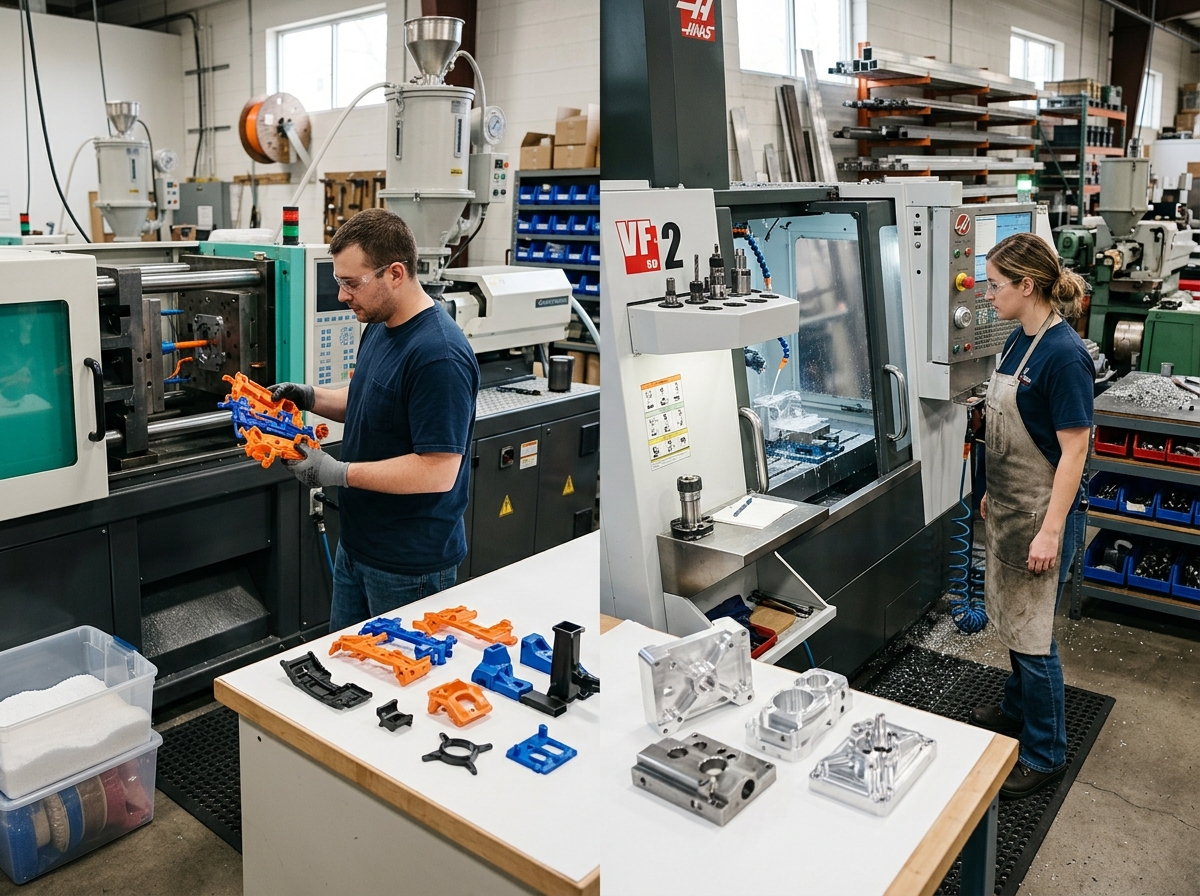
The main difference is that molding creates parts from a cavity, while machining removes material from a solid block. That distinction affects cost structure, lead time, surface finish, material waste, and design constraints.
For projects that require stable dimensions and high repeatability, molded production is often preferred. For projects that need design iteration or small batches, machining can reduce upfront risk and shorten the path to first article testing.
Comparison Table: Core Differences Between Injection Molded Parts and CNC Machining
| Factor | Injection Molded Parts | CNC Machining |
|---|---|---|
| Best volume range | Medium to high volume | Low to medium volume |
| Upfront cost | Higher because of tooling | Lower because no mold is needed |
| Per-part cost | Usually lower at scale | Usually higher as volume rises |
| Design changes | Slower and more expensive | Faster and easier |
| Material waste | Low | Higher due to subtractive cutting |
| Repeatability | Very strong after process control | Strong, but depends on setup and fixturing |
Industry standards also treat molded parts differently from metal parts because plastics behave differently under load and shrink during cooling. ISO 20457 states that molded plastics require their own tolerance and acceptance framework, which is why dimensional planning matters from the start. ISO guidance on molded-part tolerances is especially relevant when a project depends on fit, seal, or assembly consistency.
When CNC Machining Services Are the Better Choice
CNC machining services are the better choice when speed, revision freedom, and low-volume economics matter most. This is common in concept validation, pilot builds, and custom fixtures where tooling would be too expensive or too slow.
Machining is also useful for parts with sharp internal features, deep pockets, or unusual geometry that would complicate mold design. In those cases, the process can reduce development friction and help teams confirm the design before scaling.
- Prototype parts that may change after testing
- Short-run functional components
- Engineering samples for fit and assembly checks
- Parts with complex secondary machining requirements
For projects that require dimensional verification, NIST emphasizes high-accuracy dimensional measurement as part of industrial competitiveness and quality systems. NIST dimensional metrology resources support the broader principle that measurement planning should match the part’s functional requirements.
When Custom Plastic Parts Are the Better Choice
Injection molded parts are the better choice when the design is stable and the project needs repeatable output. Once tooling is approved, the process usually delivers lower unit cost, consistent appearance, and efficient production for ongoing demand.
This is especially important for housings, consumer products, packaging components, and OEM assemblies. In these categories, the economics of tooling are often justified by volume, and the process supports stable supply planning.
Comparison Table: Typical Project Fit by Manufacturing Method
| Project Need | Better Fit | Reason |
|---|---|---|
| Rapid design iteration | CNC machining | No mold changes required |
| High-volume repeat orders | Injection molding | Lower unit cost after tooling |
| Decorative or consumer housings | Injection molding | Better finish and repeatability |
| Functional samples | CNC machining | Faster engineering feedback |
| Long-term OEM supply | Injection molding | Stable production economics |
For companies that need both tooling and production support, one-stop mold development can reduce handoff risk. The target website’s professional injection moulding services and OEM custom plastic parts service pages reflect that integrated workflow.
Key Takeaways for Project Teams
- Choose CNC machining first if the design is still changing.
- Choose molding first if the part will be repeated at scale.
- Use tolerance planning early, not after tooling starts.
- Evaluate total cost, not only unit price.
- Match the process to the product life cycle stage.
These decisions become clearer when the part’s function, volume, and timeline are defined in writing. A project with uncertain geometry should usually start with machining, while a stable production program should usually move toward molding.
How to Evaluate Tolerance, Surface, and Material Risk
Tolerance control is often the deciding factor in the custom plastic parts versus CNC machining decision. Plastics shrink, warp, and respond to cooling differently from metals, so the acceptance criteria must reflect the process rather than copy a metal-part mindset.
ISO 20457 explains that molded plastics need process-specific tolerancing and acceptance conditions. That matters for snap fits, sealing surfaces, cosmetic panels, and enclosure parts where even small deviations can affect assembly. ISO’s official standard overview is a useful reference for teams defining these requirements.
Surface finish is another practical difference. Machined parts can show tool marks unless they are post-processed, while molded parts can be produced with texture or gloss directly from the tool surface. For consumer-facing parts, that can reduce finishing work and improve consistency.
Where the Target Supplier Fits in the Decision
The target supplier is positioned as a one-stop plastic manufacturing partner, which is useful when a project needs both tooling and molded output. Its product structure includes plastic injection molds, plastic case molds, PC case molds, 3D molds, and custom plastic products, so it covers several common B2B use cases.
That range matters for electronics housings, daily goods, packaging, toys, and OEM projects. A supplier with multiple mold categories can support design-to-production transitions without forcing the buyer to manage separate vendors for each stage.
Supplier Directory: Relevant Internal Product Categories
- Main website homepage for the full manufacturing overview
- PC case molds for electronic enclosure projects
- Injection moulding services for production support
- Custom plastic products for OEM and ODM development
For buyers comparing vendors, the most useful question is not whether a supplier can make a part, but whether it can support the whole development cycle. That includes design review, mold build, trial runs, modification, and production ramp-up.
Practical Decision Framework
The best manufacturing method is the one that minimizes project risk at the current stage. If the goal is to validate function, CNC machining usually provides faster feedback. If the goal is to launch a stable product line, molding usually provides better long-term economics.
Teams should also consider supply continuity, not just the first order. A process that looks cheaper at prototype stage can become expensive if it cannot scale, while a mold-based project can become inefficient if the design is still unstable.
In practice, many projects use both methods in sequence. They start with machined samples, confirm the design, then move to injection molding once the geometry and acceptance criteria are locked.
FAQ
1. Is CNC machining always more accurate than injection molding?
Not always. CNC machining can achieve excellent precision on prototypes and small runs, but molded parts can be highly consistent once the tool and process are stabilized. The better choice depends on the tolerance stack, material behavior, and whether the design is still changing.
2. Why do molded parts need special tolerance standards?
Plastics shrink and deform differently from metals during cooling and use. That is why ISO 20457 defines tolerances and acceptance conditions specifically for molded parts. The standard helps teams set realistic limits for fit, geometry, and functional performance.
3. When does injection molding become cheaper than CNC machining?
The crossover point depends on part complexity, material, cycle time, and tooling cost. In general, molding becomes more economical as volume rises because the mold cost is spread across more units. For low volumes, machining often remains the lower-risk option.
4. Can a project use CNC machining first and molding later?
Yes. That is a common development path. Machined samples help verify fit, function, and assembly before committing to tooling. Once the design is stable, the project can move to molding for repeat production and lower unit cost.
5. What should buyers ask a plastic manufacturing supplier before ordering?
Ask about design review, tolerance capability, sample approval, trial runs, modification support, and production lead time. Buyers should also confirm whether the supplier can handle both tooling and molding, because one-stop support often reduces communication errors and schedule risk.
Post time: Jul-09-2026