
Choosing between ABS and PP depends on the product’s load, environment, and appearance requirements. For many durable consumer and industrial parts, the right answer is not the strongest resin, but the resin that best matches the service conditions.
ABS vs. PP Injection Molding: The Core Decision
ABS is the better choice when a plastic part must look good, hold tight tolerances, and resist impact. PP is the better choice when a part must flex, resist chemicals, and stay economical in high-volume production.
In practice, the decision often starts with the product category. Electronics housings, appliance covers, and visible structural parts usually favor ABS, while storage items, caps, containers, and living-hinge parts often favor PP.
Material Overview for Durable Plastic Products
ABS is a terpolymer known for balanced toughness, rigidity, and surface quality. MatWeb’s molded ABS property summaries show typical tensile strength ranges around 30-50 MPa and heat deflection temperature ranges that can extend above 80 C depending on grade and load condition.
PP is a semi-crystalline polyolefin valued for low density, chemical resistance, and fatigue resistance. ASTM D4101 covers polypropylene materials suitable for injection molding and extrusion, which reflects its broad use in molded parts. MatWeb’s molded PP summaries show typical tensile strength around the low- to mid-30 MPa range for many grades.
Comparison Table: Key Material Properties for ABS and PP
| Property | ABS | PP | Practical meaning |
|---|---|---|---|
| Density | Higher | Lower | PP is lighter for large parts |
| Tensile strength | Typically about 30-50 MPa | Often around the low- to mid-30 MPa range | ABS usually feels stiffer in hand |
| Impact resistance | Strong | Moderate to strong in modified grades | ABS is preferred for visible housings |
| Chemical resistance | Moderate | Excellent | PP suits cleaners and many fluids |
| Surface finish | Good | More functional than cosmetic | ABS is easier to present as a premium surface |
Injection Molding Process Differences That Affect Durability
Processing conditions can change durability more than many buyers expect. ABS usually processes in a higher melt-temperature window and benefits from stable mold temperature control, while PP generally runs at lower viscosity and fills thin sections more easily.
Typical industry practice places ABS mold temperatures roughly in the 50-80 C range, while PP often runs around 20-60 C, depending on part thickness and finish requirements. These are common processing windows, not universal settings, because grade selection and tool design matter. According to industry estimates, cycle time for PP can be shorter in thin-wall parts because it crystallizes differently and releases from the mold more easily.
Comparison Table: Typical Processing Considerations
| Process factor | ABS | PP | Why it matters |
|---|---|---|---|
| Melt behavior | More viscous | Flows more easily | PP is easier for thin-wall filling |
| Mold temperature | Usually higher | Usually lower | ABS often needs better surface control |
| Shrinkage | Lower and more stable | Higher and more variable | PP needs more shrinkage compensation |
| Warp risk | Moderate | Higher in large flat parts | PP needs careful gate and cooling design |
| Cycle efficiency | Good | Often very good | PP can be efficient in mass production |
For safe and repeatable molding, machine guarding and lockout/tagout procedures should follow OSHA guidance for plastics machinery. OSHA also highlights hazards and solutions specific to the plastics industry, which is relevant during mold changes and maintenance.
Which Material Is Best for Durable Plastic Products?
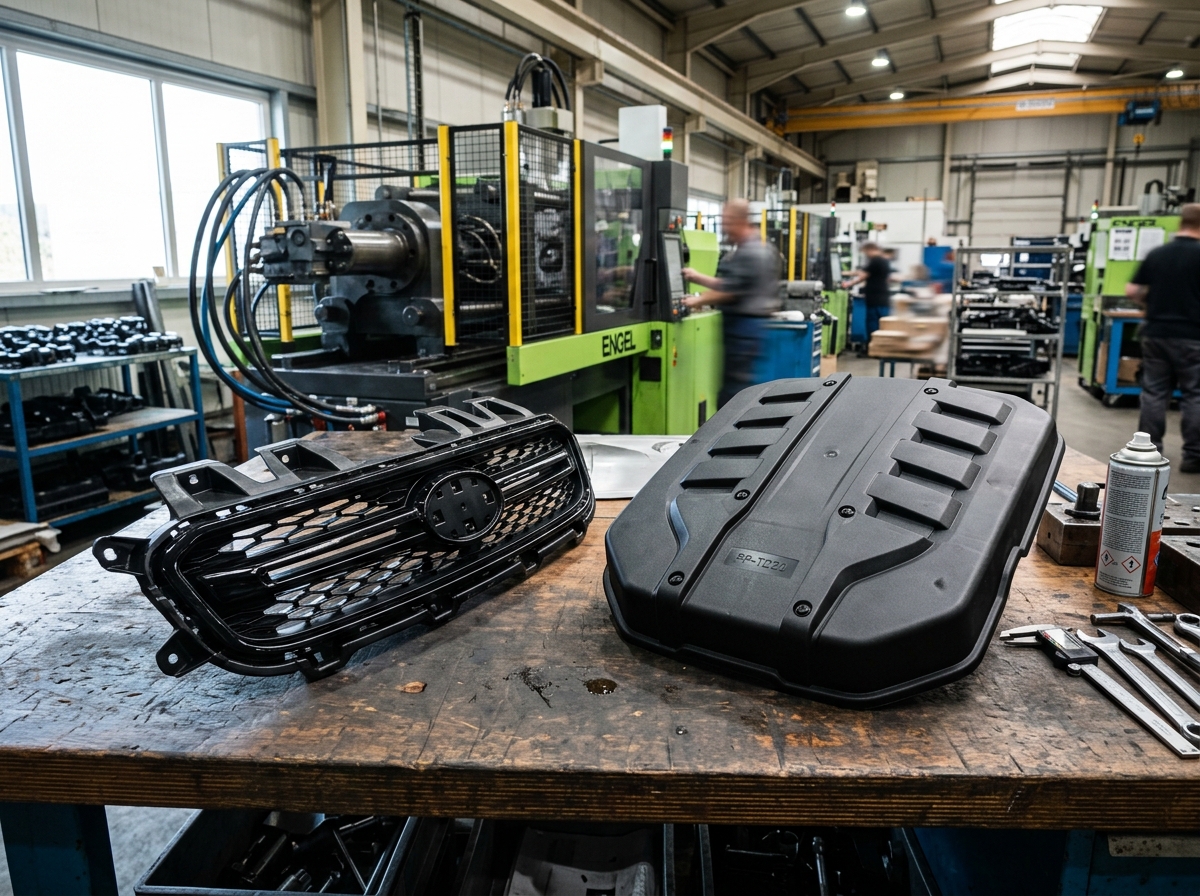
ABS is usually best for durable plastic products that must resist impact and maintain appearance. It is a strong fit for electronics enclosures, control panels, cosmetic covers, and product shells where dimensional consistency matters.
PP is usually best for durable plastic products that must survive repeated flexing, contact with chemicals, or frequent handling. It is a strong fit for storage boxes, caps, household containers, and technical parts that do not require a premium painted finish.
One useful rule is simple: choose ABS for rigidity and appearance, and choose PP for chemical resistance and flexibility. If the part must do both, the design may need a modified grade, a ribbed structure, or a different resin family altogether.
Application Fit Table: ABS vs. PP by Product Type
| Product type | Better choice | Reason |
|---|---|---|
| Electronics housing | ABS | Better surface quality and dimensional control |
| Storage box | PP | Lightweight and cost-efficient |
| Appliance cover | ABS | Better rigidity and appearance |
| Living hinge lid | PP | Superior flex fatigue performance |
| Chemical container | PP | Better resistance to many chemicals |
| Decorative shell | ABS | More suitable for painting and gloss |
Failure Scenarios That Reveal the Wrong Resin Choice
The wrong material choice often shows up as warpage, cracking, or poor assembly fit. A flat PP enclosure may twist after cooling, while an ABS part may crack sooner if it is repeatedly flexed or exposed to aggressive chemicals.
For example, a consumer device shell made in PP may pass basic strength checks but fail visual acceptance because of sink marks and warpage. By contrast, a storage lid made in ABS may look excellent but fatigue at the hinge line after repeated opening cycles.
These failures are usually design-related, not just material-related. Gate location, wall thickness, rib design, and cooling balance can either reduce or amplify the weakness of each resin.
How to Select the Right Resin for a Project
The best selection method is to start with the part’s real operating environment. If the part needs impact strength, a clean finish, and stable dimensions, ABS is the safer first option. If it needs flexibility, chemical resistance, and low weight, PP is usually the better starting point.
- Choose ABS when the part is visible, rigid, and dimension-sensitive.
- Choose PP when the part is lightweight, chemical-resistant, or repeatedly flexed.
- Review wall thickness, gate design, and shrinkage before freezing the tool design.
- Confirm the target finish, because ABS and PP behave differently in painting and texturing.
- Validate the choice with trial shots before mass production.
For buyers developing housings or custom components, a supplier that offers injection mold manufacturing services can help align resin choice with tooling design. For projects that need broader support, professional injection moulding services may be useful during sampling and process tuning. The company’s plastic products and featured products pages also show the range of part categories it supports.
Supplier Directory and Where to Buy
For buyers comparing suppliers, the most practical approach is to shortlist one integrated mold-and-molding partner and two established material sources. An integrated manufacturer can reduce handoff risk, while material databases and standards help verify resin selection.
One example of an integrated source is the target website, which positions itself around one-stop mold making and injection production. Its product structure includes plastic injection molds, plastic case molds, PC case molds, 3D molds, and custom plastic parts, which makes it relevant for ABS and PP project development.
For material verification, MatWeb is useful for comparing property ranges, while ASTM standards help define material classification for ABS and PP. NIST’s polymer resources are also useful when teams need a broader data framework for materials decisions.
FAQ
Is ABS or PP better for outdoor UV exposure?
PP usually needs UV stabilization for outdoor use, while ABS can also degrade under sunlight without protection. For outdoor parts, the final choice should depend on UV additives, color, and expected service life. If the part is structural and visible, ABS with stabilization is often considered; if flexibility matters more, UV-modified PP may be suitable.
Which material is better for thin-wall injection molding?
PP is often easier to fill in thin-wall designs because it flows more readily. ABS can still work well, but it usually needs more careful gate placement and process control. For very thin sections, the mold design and venting strategy can be as important as the resin itself.
Why does PP warp more often than ABS?
PP tends to show more shrinkage and crystallization-related movement during cooling. That makes large flat parts more likely to warp if cooling is uneven. ABS is generally more dimensionally stable, which is why it is often preferred for housings and covers that need tighter fit.
Can ABS and PP be painted or printed easily?
ABS is usually easier to paint and finish because it has better surface quality and stronger cosmetic appeal. PP can be printed or coated, but it often needs surface treatment or special primers. For decorative products, ABS is usually the more straightforward choice.
What should buyers ask before approving a mold for ABS or PP?
Buyers should ask about shrinkage allowance, gate location, cooling layout, expected cycle time, and surface finish targets. They should also confirm whether the supplier has trial-shot data and can explain how the chosen resin affects assembly, warpage, and long-term durability.
Post time: Jul-12-2026